A Young Woman’s Last Act of Strength: Ending Life on Her Own Terms.2822

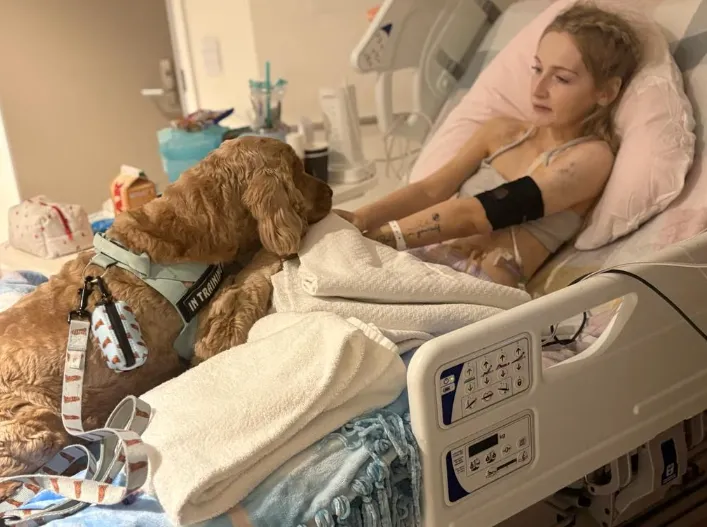
Annaliese Holland had spent so much of her twenty-five years inside hospital walls that the world outside sometimes felt like a distant dream.
For most people her age, life was only beginning — full of first jobs, first homes, new loves, weddings, babies, beginnings.
But for Annaliese, life had been a series of medical rooms, fluorescent lights, pain scales, IV poles, and days measured not in joy, but in how many crises she could survive before nightfall.

She had lived her whole life carrying a body that betrayed her.
A body that one day stopped digesting food.
A body whose nerves slowly died.
A body that refused to obey the simple commands needed to survive.
And she was tired — tired in a way that no rest and no medicine could cure.

Born and raised in Adelaide, South Australia, Annaliese had been a bright, warm child — sharp-witted, curious, endlessly polite.
Her parents used to joke that she “apologized for everything,” even for things that weren’t her fault.
But as she grew, her world began shrinking.
Hospitals became her second home by the time she was ten.
Doctors searched for answers but found none.
She grew up not with birthday parties or school dances, but with feeding tubes, scans, and pain she never fully understood.

By her teens, the symptoms multiplied.
Chronic pain.
Vomiting every day.
Constant nausea that stole her appetite and her joy.
At sixteen, she could no longer eat or drink enough to survive, and doctors placed her on total parenteral nutrition — TPN — artificial nutrition pumped directly into her bloodstream.
“It was like living on borrowed time,” she once said.
Every day on TPN came with the risk of infection.
Every infection risked sepsis.
And sepsis, if not caught in time, would kill her within hours.

She survived sepsis twenty-five times.
Twenty-five times her body was pushed to the brink, pulled back only by emergency intervention and her own stubborn will to live.
But every rescue left scars — organ damage, new weaknesses, deeper exhaustion.
Her spine fractured in four places.
Her sternum split open.
Her heart and lungs were nearly crushed.
Her bones, weakened by steroids, began dying from the inside out.
Her teeth blackened, loosened, and fell.
“It felt like my body was disappearing,” she said once, quietly.
“And I was disappearing with it.”

When she turned eighteen and moved from paediatrics to adult care, doctors finally found the name for the monster destroying her life — autoimmune autonomic ganglionopathy.
A rare neurological disease that attacked the nerves controlling the most basic human functions: heart rate, blood pressure, digestion, urination, temperature.
There was no cure.
No treatment.
Only the knowledge that it would get worse.
By twenty-two, she was told the truth no young woman should ever hear — her condition was terminal.
Her body was failing, slowly but surely.
Organ by organ.
System by system.

For a while, she fought anyway.
She endured the medications, the surgeries, the complications, the infections, the pain.
She squeezed joy from small things — a laugh with her sister, a visit from a friend, moments of sunshine between long hospital stays.
But she was not living.
She was surviving — the kind of survival that feels less like life and more like being trapped in a body that refuses to let go.
She watched her peers graduate, travel, marry, have children.
She watched life move forward without her.
“I’m stuck,” she often whispered.
“I’m just stuck.”

Her disease felt like “walking on a field of landmines.”
Every day could be the one that killed her — another sepsis, another organ failure, another collapse.
She lived with the anxiety of not knowing which moment would be her last, and whether she would suffer when it happened.
Then came the day everything changed.
During one of her many hospital stays, she caught a glimpse of herself in a mirror — thin, fragile, swollen in places from steroids, sunken in others from malnutrition.
Her teeth darkening.
Her skin pale.
Her eyes tired beyond her years.
“It wasn’t me,” she said.
“It wasn’t the girl I used to be.
And I just felt… exhausted.”

That night, she told her family she wanted to choose her ending — not wait for the illness to take her in agony.
She wanted medical aid in dying.
She wanted to go gently, peacefully, surrounded by love, instead of in a frantic emergency room with doctors fighting for a body that had already given everything it could.
Her parents were devastated.
A mother never stops praying for miracles.
A father never stops believing his daughter can hold on a little longer.
They had watched her fight her whole life.
They had seen her survive the impossible.
How could they let her go?

Her father, Patrick, struggled the most.
He had witnessed every brush with death, every resuscitation, every tear.
“She fights every time,” he said.
“She never gives up.”
But Annaliese reached a point where she had nothing left to give.
She remembered sitting with him in the kitchen, her voice barely above a whisper.
“Dad, I’ve had enough.”
“So you’re giving up?” he asked, hurt in his voice.

But it wasn’t giving up.
It was acknowledging that she had fought more battles than most people could survive.
And she had fought them bravely.
The moment that changed him came weeks later.
She had just been resuscitated again.
Her chest hurt from compressions.
Her mind fogged.
Her body bruised and broken.

With tears streaming down her face, she looked up at him and said, “Dad, please let me go.
I won’t hate you.
I promise.
Please just let me go.”
She wasn’t crying because she was scared of death.
She was crying because she was scared of hurting her family.
She had always carried that fear — more painful than any physical agony.
“I don’t want to wake up every day terrified of the pain that’s coming,” she said.
“The pain of starvation if they can’t feed me.
The pain of sepsis.
The pain of my organs shutting down.
I can’t do it anymore.”

Three weeks of psychological evaluations and legal reviews followed.
When the approval finally came, she sobbed — with relief, not despair.
“This is my safety blanket,” she said.
“My peace.
My choice.”
Medical aid in dying (MAID) or voluntary assisted dying (VAD) is legal in all Australian states for terminally ill adults who are mentally competent.
Unlike euthanasia — where a doctor administers the drugs — MAID requires the patient to take the medication themselves.
It is an act of agency, not surrender.
“I know it sounds strange,” she smiled softly, “but I felt happy when they approved it.
It felt like a weight off my shoulders.”

Still, she carries guilt.
“For me,” she said, “I go from pain to peace.
But my family goes from peace to pain.
I think about that every day.”
She is thoughtful about how she wants her final moments to unfold.
She does not want to cause more hurt than necessary.
But she also knows that forcing herself to stay alive in agony would break her family more than her peaceful goodbye.
“It’s one of the bravest things you could ever do,” she said, her voice steady.
“To say: I want VAD.
It’s not giving up.
It’s saying: I’ve had enough, and I fought bloody hard.”
She does not fear the end.
She fears suffering.
She fears taking one more breath that feels like fire.
She fears the next infection that could torture her for hours before ending her life suddenly.
Having the choice means she has control — something illness stole from her long ago.
And now, for the first time in years, she feels calm.
Peaceful.
Like she is standing at the edge of a long, painful chapter, finally able to close it gently.
“I’m lucky,” she says.
“Not everyone gets to choose.
Not everyone gets to say goodbye the way they want.
I do.
And that means everything.”

Her life was short, but it was filled with courage.
Her days were painful, but they were lived with grace.
Her story is heartbreaking — but also filled with a quiet, powerful beauty.
Because Annaliese Holland’s final act is not one of defeat.
It is one of love, dignity, and the bravery to say: Enough.
Let me rest.
Jasper’s Brave Fight Against Cancer.722

Four-year-old Jasper is a warrior in the truest sense. Every day, he faces challenges that no child should ever have to confront. Cancer has tested his body and spirit, yet his courage shines through in the smallest moments—when he reaches for a toy, whispers a word, or flashes a shy smile at a nurse.
His parents, unwavering in their love, have become his steadfast anchors. They hold his tiny hands during needle pokes and IVs, soothing his cries and wiping away tears. They celebrate every milestone, no matter how small—a sip of water without gagging, a short walk down the hospital corridor, or a simple laugh shared with a visiting sibling. These moments, though seemingly ordinary, are victories carved from struggle.
Jasper’s siblings, too, are learning lessons that no textbook could teach. From his bravery, they learn what it means to persevere, to love unconditionally, and to hope even when the outcome feels uncertain. They watch him confront pain without complaint, and in doing so, they absorb courage, resilience, and the quiet strength of the human spirit.

The journey has been far from smooth. There have been setbacks—days when fever and fatigue left Jasper pale and weak, nights when alarms rang and doctors hurried through procedures, and moments when his family feared the worst. Yet through every obstacle, Jasper’s determination never faltered. Every time he takes a tentative step, says a whispered word, or laughs softly, his family is reminded that even the smallest victories are worth celebrating.
Now, back at home, Jasper is slowly reclaiming the joys of childhood. He walks a little further each day, speaks a few more words, and fills his home with laughter and warmth. He still faces challenges, but each day brings a reason to marvel at his strength. Visitors who meet him are struck not just by his condition, but by his spirit—an unspoken reminder that courage can come in the tiniest of bodies.
Jasper’s story is far from over. Every day adds a new chapter of hope, love, and resilience. He reminds everyone who meets him or hears of his journey that even the smallest fighter can leave the brightest mark on the world. And for his family, each moment of normalcy, each hug, and each shared smile is a triumph worth cherishing—a testament to love, endurance, and the power of hope in the face of life’s fiercest battles.