NSW Officer Remains in Critical Condition After Bondi Beach Attack.5955

In the days after the December 14 terror attack at Bondi Beach, the shoreline of Sydney no longer felt like a place of leisure.
Flowers lined the walkways, candles flickered against the ocean breeze, and handwritten notes lay pressed beneath stones to keep them from blowing away.
What had once been a symbol of summer and freedom became a space of grief, reflection, and unanswered questions.
For many families, the pain of that day arrived suddenly and irrevocably.
For others, the suffering did not end with the sound of gunfire, but continued in hospital corridors and operating rooms.
Among them was the family of Scott Dyson, a 25-year-old NSW Police constable whose life was forever altered while responding to the attack.
Scott was critically injured while doing what he had trained for and believed in: protecting the public in a moment of terror.
The bullets that tore through Bondi Beach did not distinguish between bystanders and first responders.
They left behind a trail of devastation that would stretch far beyond that single afternoon.
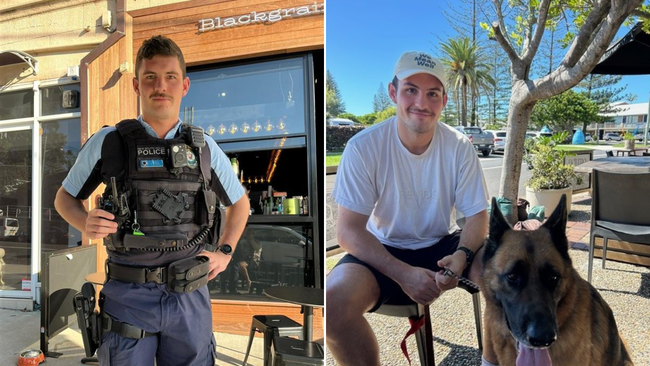
In a somber update released by his family, the reality of Scott’s condition was laid bare.
Since the shooting, he has been undergoing surgeries “almost daily,” a relentless cycle of procedures aimed at saving his life and rebuilding what was damaged.
Each operation marks both progress and uncertainty, a reminder that survival often comes at an immense physical and emotional cost.
Earlier this week, there was a fragile moment of hope.
Scott emerged from a medically induced coma, opening his eyes to a world that no longer looks the same.
For his family, it was a milestone filled with relief, fear, and overwhelming emotion.
Waking up, however, was not the end of the battle.
It was the beginning of a long and arduous recovery that doctors caution could take years.
The injuries he sustained were severe, and the road ahead remains unpredictable.
Hospital rooms have become the family’s new reality.
Days are measured in surgical schedules, specialist consultations, and careful monitoring of vital signs.
Nights are spent waiting for updates, clinging to small improvements, and bracing for setbacks.
Scott’s parents have spoken of the emotional toll in quiet, measured words.
They describe exhaustion that seeps into the bones, mixed with gratitude that their son is still alive.
Hope, they say, now exists in fragments — a movement of a hand, a steady heartbeat, a moment of awareness.

The December 14 attack itself has been etched into the memory of the nation.
Fifteen lives were lost in an act of violence that shattered a sense of safety in one of Australia’s most iconic public spaces.
Dozens more were injured, their lives diverging sharply from the paths they were on just hours before.
For first responders like Scott, the impact was twofold.
They were forced to confront chaos and danger while racing toward screams, not away from them.
In doing so, they placed themselves directly in harm’s way, embodying a commitment that most people never have to test.
Colleagues from the New South Wales Police Force have described Scott as dedicated, calm, and deeply committed to service.
At just 25, he was still early in his career, full of ambition and pride in the uniform he wore.
That uniform now hangs differently in the public imagination — a symbol not only of authority, but of sacrifice.
Across Sydney, vigils have continued in the weeks following the attack.
Strangers stand shoulder to shoulder, united by grief and a shared refusal to let the victims be forgotten.
Scott’s name is often spoken among them, a reminder that survival does not mean the absence of suffering.

Mental health professionals warn that recovery from such trauma extends beyond physical wounds.
Survivors and first responders alike may carry psychological scars that are invisible but deeply felt.
Flashbacks, anxiety, and survivor’s guilt often surface long after media attention fades.
For Scott’s family, these concerns loom alongside the immediate medical crisis.
They know that healing will involve not just surgeries, but time, therapy, and unwavering support.
The man who entered Bondi Beach on December 14 will not be the same man who eventually leaves the hospital.
Yet within that reality exists a powerful sense of pride.
Pride in Scott’s courage, in his refusal to hesitate when others were in danger.
Pride in knowing that his actions may have helped prevent even greater loss of life.
The public response has been immense.
Messages of support, donations, and letters have poured in from across Australia and beyond.
Many come from people who have never met Scott, but feel connected to him through shared humanity and gratitude.

His family has expressed deep appreciation for that support.
They say it serves as a reminder that Scott’s sacrifice has not gone unnoticed.
In moments of despair, those messages help them keep going.
The broader conversation about public safety and extremism has intensified in the aftermath of the attack.
Questions about prevention, response times, and community resilience are being asked at every level of government.
But for families like Scott’s, those debates exist alongside a far more personal reality.
They are not thinking in terms of policy.
They are thinking about pain management, infection risks, and whether today’s surgery will bring progress or complications.
Their world has narrowed to a hospital ward, even as the nation grapples with the meaning of the tragedy.
Doctors remain cautiously optimistic.
They emphasize that Scott’s youth and strength work in his favor, even as they acknowledge the severity of his injuries.
Recovery, they stress, will not be linear.

There will be moments of improvement followed by days of frustration.
There will be victories so small they might seem insignificant to outsiders.
But for Scott and his family, each one will matter deeply.
As weeks turn into months, the story of the Bondi Beach attack will continue to evolve.
Court proceedings, investigations, and official reports will eventually provide clarity on how and why it happened.
None of them, however, will fully capture the human cost.
That cost is written in hospital charts, in sleepless nights, and in the quiet determination of families refusing to give up.
It is written in Scott Dyson’s ongoing fight to heal.
And it is written in a nation learning, once again, how fragile ordinary days can be.

For now, Scott remains under constant medical care.
Surgeries continue, one after another, each representing both survival and sacrifice.
His family waits, hopeful but realistic, grounded by love and resilience.
They know the road ahead will be long.
They also know that Scott has already defied odds simply by being alive.
In that truth, they find the strength to face whatever comes next.
Abandoned No More: A Dog Finds His Second Chance.278

In the dead of night, a dog was left alone—confused, frightened, and unsure why the only people he had ever known had vanished. For six long days, he remained in the same spot, as if holding onto hope that someone would return. His eyes, clouded with fear and sadness, followed every movement around him, watching, waiting, enduring. Yet when no one was looking, he would quietly trail behind, curious but cautious, yearning for connection while hiding his vulnerability.
He was clever, too clever for ordinary traps. Volunteers tried to approach, to coax him to safety, but he always slipped away, evading every attempt to capture him. It seemed as though he had resigned himself to a life of cautious solitude, holding onto a fading hope that his owners might come back.

Then something shifted. Perhaps it was the quiet understanding that they were never returning, or maybe the sight of another dog receiving love and care—it sparked something inside him. That day, he allowed someone to clip a lead to his collar. For the first time in nearly a week, his tail wagged, hesitant at first, then with growing enthusiasm. A small flicker of trust had been restored, and with it, the door to a new life.
Now, he is young, gentle, and ready to embrace the world anew. Soon, he will be neutered, vaccinated, and microchipped—a life of safety, care, and love finally within reach. The journey ahead promises walks, cuddles, and laughter—moments he never experienced before but will cherish endlessly.
Many abandoned dogs never get this chance. Many remain on the streets, overlooked and forgotten, their hope dwindling day by day. But this one did. He survived the fear, the loneliness, and the heartbreak of being discarded, and he stepped into a future filled with possibility.
His story is a quiet reminder that rescue is not just about saving a life—it’s about giving hope, restoring trust, and proving that even those left behind can find a place to belong.