A Note on the Couch — And Two Sisters Who Never Came Home.5916

Every morning in that Chicago apartment once began with noise, with the scrape of chairs and the hum of a television warming up for cartoons.
On that Friday, Tracey Bradley believed it would be no different, just another ordinary day with ordinary rules.
She kissed her daughters goodbye at 6 a.m. and reminded them, as she always did, not to open the door for anyone.
She expected to be gone only six hours.
Six hours felt safe, manageable, predictable.
She had no reason to believe the world could collapse in that amount of time.

When Tracey returned at noon, the quiet hit her first.
It wasn’t peaceful quiet, but the kind that feels wrong in a home with children.
No laughter, no arguing, no familiar chaos filled the rooms.
She called out their names, expecting answers from behind a door or down the hall.
Nothing came back to her.
The silence pressed against her ears until it felt physical.
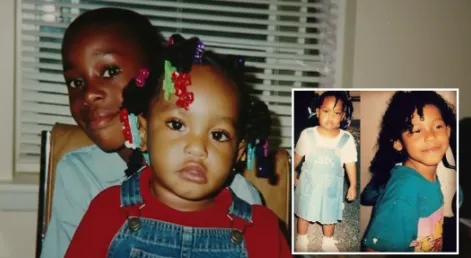
Then she saw the paper on the couch.
It was small and folded, placed where it could not be missed.
Her heart skipped before her mind had time to catch up.
The handwriting was unmistakable.
It belonged to her 10-year-old daughter, Tionda.
“We went to the playground,” the note said.
For a fleeting moment, relief washed over her.
The playground was close, familiar, safe in her mind.
Children went there every day without incident.
That relief vanished almost instantly.
Tionda never left notes.
She always called her mother first, always asked permission.
Tracey felt her hands begin to shake.
A sense of dread replaced logic.
Something about the note felt wrong, deeply wrong.
She ran to the playground, scanning every swing and slide.
It was empty, the metal warm under the summer sun.
No Tionda, no Diamond, no sign they had been there.
She widened her search, moving faster with each block.
The nearby shopping center offered nothing but confused faces.
No one had seen two little girls together that morning.
Panic settled in as the hours passed.
Tracey’s voice cracked as she asked stranger after stranger the same questions.
Each answer deepened the growing fear.
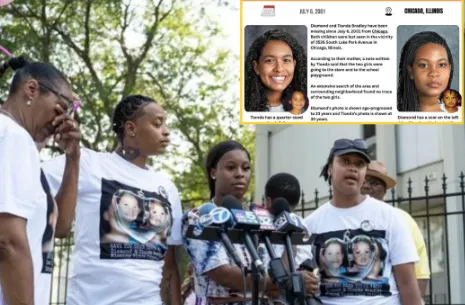
By evening, police were called.
What began as concern quickly escalated into alarm.
Two children did not simply disappear without leaving traces.
As night fell, helicopters cut across the sky.
Searchlights swept rooftops and alleyways.
The sound became a grim soundtrack to the neighborhood’s anxiety.

By midnight, the case had outgrown the local response.
Federal agents arrived, understanding the urgency.
A missing child case grows colder with every passing hour.
By morning, hundreds of officers were searching.
They knocked on doors, questioned residents, retraced steps.
Hope clung to every small lead, no matter how thin.
The city watched as news spread.
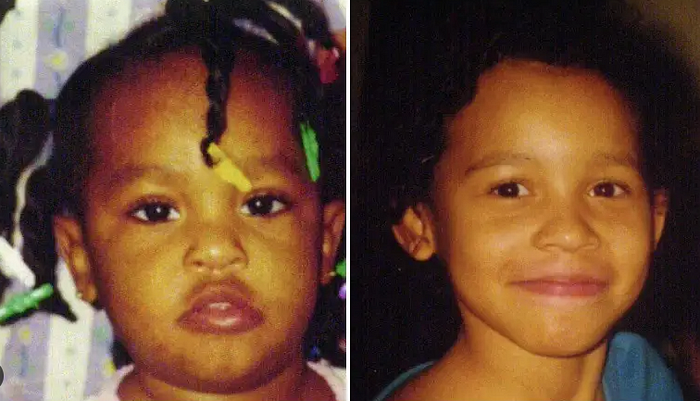
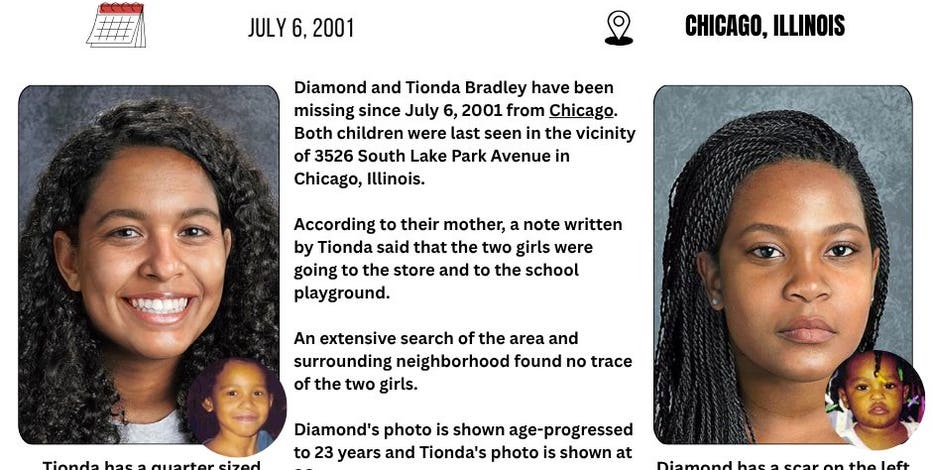
Photos of Tionda and three-year-old Diamond filled television screens.
Two smiling faces became symbols of a nightmare unfolding.
Investigators focused on the note.
It was both the only clue and the most unsettling one.
Something about it didn’t align with Tionda’s careful nature.

She was responsible, protective of her little sister.
Breaking routine was not something she did lightly.
Experts wondered what could have convinced her to do so.
Questions multiplied without answers.
Did someone speak to the girls through the door.
Did they trust a voice they thought they knew.
Tracey replayed the morning endlessly.
Every goodbye, every instruction echoed in her mind.
Guilt crept in, unwelcome and relentless.
Days turned into weeks.
Search efforts intensified, then slowly shifted.
The optimism of early hours gave way to heavy uncertainty.
Volunteers joined the search, driven by empathy and fear.
Flyers covered telephone poles and storefront windows.
The girls’ faces became heartbreakingly familiar.
The apartment itself felt different now.
Toys sat untouched, beds neatly made.
Time seemed frozen inside those walls.
The playground received new swings over the years.
Children returned, laughter filling the space again.
Yet for Tracey, it would never feel the same.
As months passed, theories emerged.
Some were whispered, others shouted.
None brought the girls home.
Twenty-four years have passed since that morning.
The case remains unsolved, suspended in unanswered questions.
Time moved forward, but closure never arrived.
Tracey grew older carrying the weight of that silence.
Every birthday, every holiday reopened the wound.
Grief became something she learned to live with, not escape.
Somewhere, the truth still exists.
It lives in a memory, a choice, a moment frozen in time.
Someone knows what happened in those six hours.
The note remains a haunting artifact.
A simple sentence that changed countless lives.
Words written by a child who should have been safe.

People still ask what made Tionda break her routine.
What fear or trust guided her steps that morning.
What final moments shaped her decision.
The story is not just about disappearance.
It is about innocence interrupted.
About how fragile normal life can be.
In Chicago, the case still lingers in quiet conversations.
Parents hold their children a little tighter.
Warnings carry heavier meaning.
The silence Tracey walked into that day never truly left.
It followed her into every room of her life.
A reminder of how quickly everything can change.
This is not a story with an ending.
It is a story still waiting for truth.
Still waiting for answers.
And somewhere, the echo of that question remains.
What happened to Tionda and Diamond.
What was hidden inside a note that should never have been written.
Through Fire for Family: A Brother’s Unshakable Love.612

The night began like any other. For 20-year-old Derrick Byrd, home was a place of warmth, laughter, and the chaos that comes with younger siblings. But in an instant, everything changed.
A deafening boom shook the house, followed by the piercing screams of his sister. Derrick bolted upright, his heart racing. Smoke poured into the hallways, flames clawed up the walls, and the home that had cradled so many memories was turning into a furnace before his eyes.
There was no time to think—only to act. His family was trapped.
Through the thick haze, Derrick reached his younger brothers, Junior, six, and Rory, just three years old. The upstairs windows were their only chance. With fire closing in, Derrick urged them to jump. One by one, they leapt into the darkness, and Derrick caught them in his arms, shielding their small bodies from the hard ground below.

But then came the most terrifying moment of all. His sister Mercedes, just eight years old, was still inside. She was coughing, panicked, and frozen by fear as the fire surged closer. Without hesitation, Derrick turned back toward the inferno. The heat seared his skin, but he pushed forward, wrapping his shirt around her, pressing her face against his chest to shield her from the flames. With strength fueled only by love, he carried her through the blaze, stumbling out into the night air with her still clutched tightly in his arms.
His body was burning, but his mind stayed fixed on one thing: his family’s survival. Even after pulling everyone to safety, Derrick didn’t stop. He ran to neighbors’ houses, pounding on doors to warn them. He sprinted block after block—ten in all—desperately searching for help. By the time firefighters arrived, there was nothing left of the house but smoldering wreckage. The home was gone. But every person inside had lived.
Derrick was rushed to the hospital, his body marked by second- and third-degree burns. Yet lying in his bed, bandaged and in pain, his words were simple: “I would do it again.” He refused the title of hero. To him, he was only a brother doing what had to be done.
But to everyone who hears his story, Derrick’s courage speaks louder than any flame. In those critical moments, he showed the purest form of bravery—instinctive, selfless, and born of love. He risked his life not for glory, but for the small voices that cried out for him in the fire.
Some lives are measured in years. Others are measured in moments. On that night, Derrick Byrd’s moment became one that will never be forgotten.