“The Little Boy Who Lost an Eye — But Not His Bravery”.4665

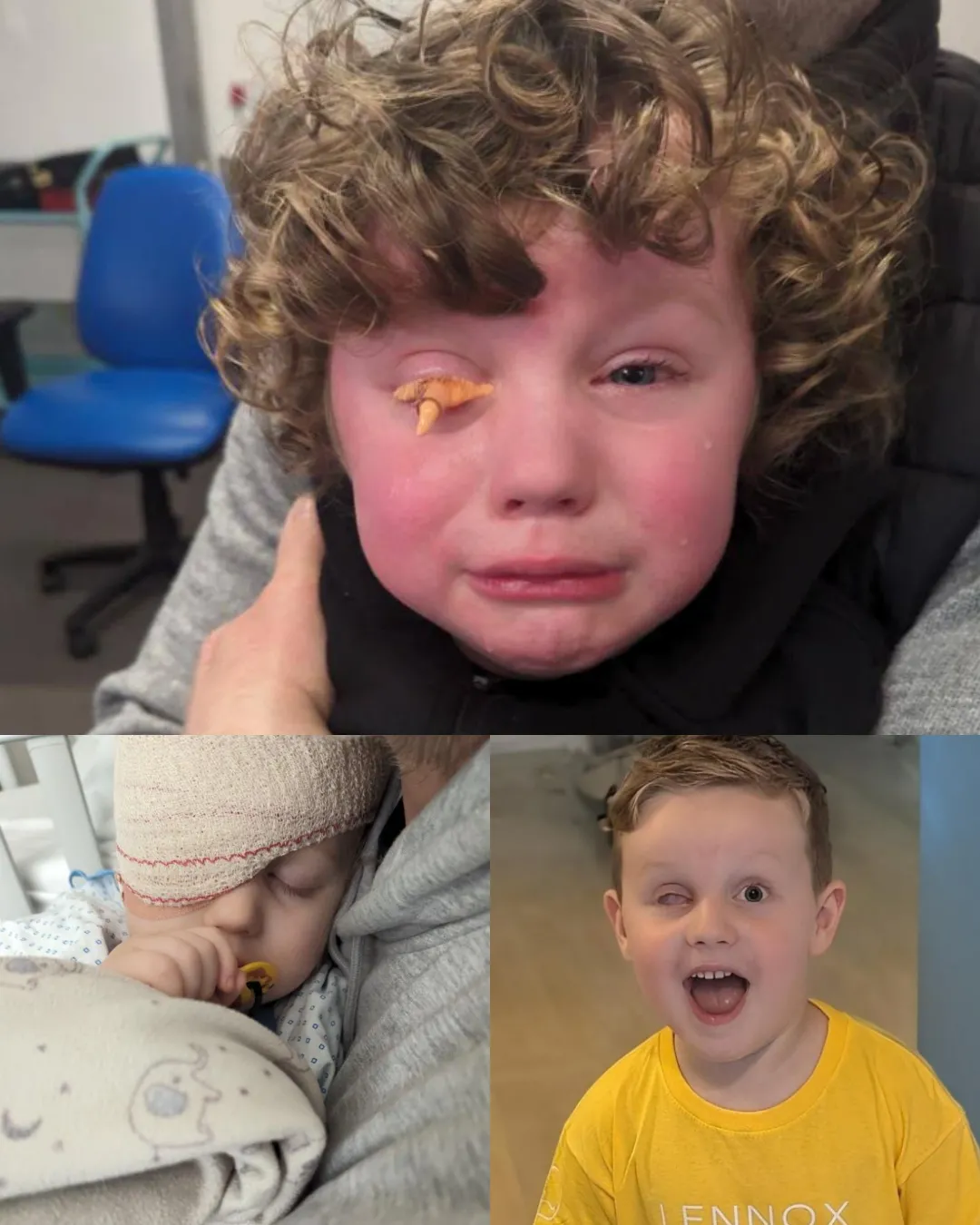

Teddy was only four years old when the world began to tilt beneath his feet — though he had no idea why. At first, there were small things: moments when he seemed to look past people instead of at them, times when his parents caught a strange reflection in his right eye, flashes of white in photos where there should have been red. Nothing that screamed emergency, but nothing that felt quite right either.
By September 2023, the truth finally came crashing in.
Doctors told his parents the word no family ever wants to hear — Retinoblastoma, a rare and aggressive childhood eye cancer. And just like that, childhood innocence collided with medical reality. The teddy bear he carried into the hospital suddenly seemed too small to hold all the fear that filled the room.
But what happened next would show just how extraordinary a four-year-old can be.

A LIFE-CHANGING DIAGNOSIS
The tumour in Teddy’s right eye was large — too large for doctors to save the eye. Chemotherapy alone wouldn’t stop it. Radiation wouldn’t be enough.
There was only one option: enucleation, the complete surgical removal of his eye.
No parent is ever prepared to hear that surgeons must remove part of their child to save the rest of them. Teddy’s mum later said she felt the world “fold in on itself,” as though reality was suddenly too heavy to carry.
The operation was scheduled quickly. There was no time to sit with the fear.
No time to bargain.
No time to ask “why us?”
Just time to act — because acting meant saving Teddy’s life.
And on the day of the surgery, Teddy walked into the operating room holding his favourite toy car, bravely trusting the adults who promised he would be okay.

THE DAY THE WORLD WENT DARK ON ONE SIDE
Enucleation is a word most people never hear. But for Teddy’s family, it became the turning point.
When he woke up from surgery, one side of his world was gone — not blurred, not dimmed, but replaced by stitches and swelling where his eye once was. The tumour had been removed completely, but the absence left behind a different kind of wound.
He reached up, touched the bandage, and asked the question no parent can ever truly prepare for:
“Will my eye come back?”
His parents held him tightly, fighting their own tears as they told him the gentlest truth they could. What mattered most was that Teddy was still here — still warm, still breathing, still theirs.
And even though he didn’t understand everything that had happened, he understood one thing deeply:
He had survived.

FREQUENT CHECKS — AND THE FEAR OF WHAT THEY MIGHT FIND
Unlike many children with Retinoblastoma, Teddy didn’t need chemotherapy. The tumour was removed before it could spread, and for that, his family will forever be grateful.
But cancer rarely leaves quietly.
A mutation was discovered in the tumour, one that raised questions and worries none of them had expected. To make sure nothing had spread or gone unnoticed, Teddy now travels regularly to
Great Ormond Street Hospital (GOSH) and Royal London for continuous monitoring:
-
eye examinations,
-
MRI scans,
-
detailed check-ups that peel back every layer of uncertainty.
Every visit brings a small, quiet fear. What if they find something this time? What if the mutation means more trouble is waiting?
It is a fear the family carries silently — but Teddy, in his innocent resilience, never lets it stop him from smiling.

LEARNING TO LIVE WITH A PROSTHETIC EYE
Every few months, Teddy visits the
National Artificial Eye Service, where skilled specialists create his fitted prosthetic eye. For adults, this process would be intimidating. For a four-year-old, it is overwhelming.
Moulds have to be taken. Measurements made. Adjustments refined. All while Teddy sits patiently, trying his best not to flinch as strangers lean close to his face.
The prosthetic eye helps him look like the little boy he was before cancer — whole, bright, unchanged on the surface. But beneath the surface, he is someone transformed. Someone who has already survived what many adults never will.
Soon, Teddy will begin play therapy — a gentle, child-centered way to help him overcome his fear of hospitals and people touching his face. These fears didn’t exist before cancer. They were learned through pain, through procedures, through the countless hands and tools that came too close too often.
Therapists will help him build trust again, rebuild a sense of safety, and relearn what it feels like to breathe easily in a hospital corridor.
It is healing not for his body — but for his heart.

A LITTLE BOY WHO REFUSES TO BE DEFINED BY WHAT HE LOST
Despite everything — the surgery, the follow-ups, the fear, the prosthetic eye — Teddy still shines.
He still laughs at silly jokes.
He still runs faster than his parents can catch him.
He still plays with his toy cars like the world is one big racetrack.
He still wakes up every morning ready to explore, ready to be loud, ready to live.
Retinoblastoma took his eye, but it did not take his spirit.
His family says he amazes them every single day — with his courage, his sweetness, and the quiet strength that seems too large for such a small child. It is the kind of strength that makes adults stop and wonder how children, in all their innocence, can be so incredibly brave.

A STORY THE WORLD NEEDS TO HEAR
Teddy’s journey is now part of the Go Gold campaign for Childhood Cancer Awareness Month — a campaign created not just to share stories of survival, but to remind the world of something urgent:
Childhood cancer doesn’t always look like what we expect.
It doesn’t wait.
And it doesn’t discriminate.
Sometimes, it shows up as a strange glow in a child’s eye.
Sometimes, it’s a headache, a limp, a fever.
Sometimes, it’s invisible until it suddenly isn’t.
But what it always brings — always — is a child who must grow up too fast and a family forced into a world they never asked to enter.
Teddy’s story is not just about loss or illness.
It is about resilience.
About love.
About a little boy who will not be broken.

A FUTURE FILLED WITH HOPE
Today, Teddy moves through the world with one eye — and more courage than most people will ever know. His prosthetic fits beautifully. His check-ups continue. His spirit continues to glow brighter than anything cancer tried to take.
His parents say they look at him and see not what he has lost, but everything he still is — joyful, curious, mischievous, unstoppable.
And though the road ahead will include more appointments, more MRIs, and more adjustments to his prosthetic eye, one thing remains certain:
Teddy is here.
Teddy is thriving.
And Teddy is showing the world exactly what it means to be brave.
His story is one piece of a much larger fight — a fight for awareness, for early detection, for research, and for every child who deserves a chance to live a full, beautiful life.
Go Gold for them.
Go Gold for Teddy.
One Tiny Vein, One Big Prayer: Camilo’s Battle for an IV.1902
Camilo’s Fight for a Simple IV Line
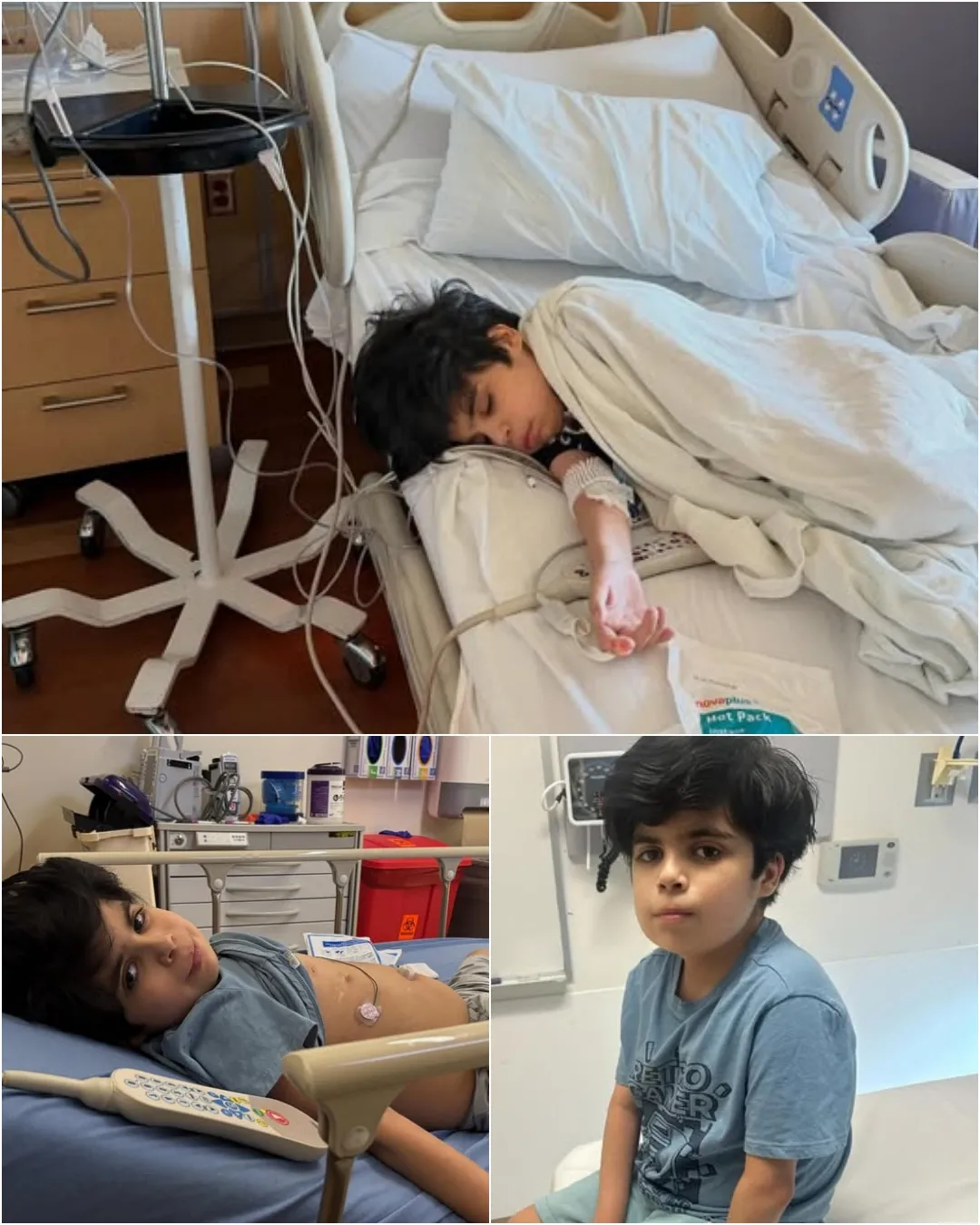
Getting IV access for most people is a routine medical step. A nurse comes in, ties a tourniquet, looks for a good vein, and within minutes, the needle is in place. But for Camilo, a boy who has spent far too much of his young life in hospital rooms, that simple step is anything but routine. For him, it’s a battle—both physical and emotional—that leaves his parents holding their breath each and every time.

Every IV attempt begins with tension. For Camilo, the sight of a needle already stirs panic. He knows what’s coming. The sharp poke is painful, but worse is the uncertainty that follows: Will it work? Or will this vein fail, like so many others?
Camilo’s veins are small and fragile—tiny streams that collapse easily when he’s dehydrated. And because his body has been through so much, dehydration is often part of the picture. To make matters more complicated, when fear and pain cause him to tense his muscles, those little veins shrink even more, almost disappearing from view. It means that even when a nurse manages to place the needle, the IV often blows within minutes, wasting both his energy and his courage.

For children like Camilo, IV access isn’t just uncomfortable—it’s traumatic. Each failed attempt leaves scars, not only on his arms but also on his spirit. His mom describes it as “a huge emotional trigger.” The anxiety builds before the nurse even enters the room, and by the time the process begins, Camilo is already fighting back tears, bracing himself for yet another round.

Because of how hard his veins are to find, Camilo’s care team rarely attempts IV placement without calling in the vascular access specialists—a team trained to use ultrasound to guide the process. Instead of relying on sight or touch, they carefully scan his arms, wrists, and sometimes even his legs with a small wand that reveals hidden veins on a screen.
This time, the scan brought sobering news. Out of all the possibilities, there was only one tiny vein they could even try. One chance. One fragile thread of hope. If it failed, the next option on the table would be far more invasive: placing another PICC line.

For Camilo’s parents, the words “PICC line” bring a heavy weight. He’s already had two. A PICC line—short for “peripherally inserted central catheter”—is a long, thin tube placed into a large vein that leads to the heart. It allows long-term medications, fluids, or nutrition to be given without needing repeated IV sticks. In many cases, it’s a blessing. But for Camilo, it’s also a risk.
The last time he had one placed, the interventional radiology team warned the family that future PICC lines might no longer be possible in his upper extremities. The veins there were running out of space, scarred and damaged from repeated use. That meant that if he ever needed another one, it would likely have to go into his lower extremities—his legs.

For a boy who suffers from bouts of vomiting and diarrhea so intense that he often leaps from his bed with little warning, the risks multiply. PICC lines in the lower extremities carry a much higher chance of infection and dangerous blood clots. Each infection would mean another hospitalization, another round of strong antibiotics, and more stress on a body that has already endured too much.
So when the vascular team explained the situation, Camilo’s parents felt both urgency and dread. There was a single vein left to try. They explained the plan to Camilo gently, doing their best to calm his fears, while inside they prayed with everything they had that this time, the line would go in and hold.

The process wasn’t quick. It took an hour and a half of preparation—time spent scanning, planning, cleaning, numbing, and positioning. Camilo lay there, nervous and exhausted, his parents close by, holding his hand and whispering encouragement.
And then, finally, success. The tiny vein held. The IV went in.

Relief washed over the room. The battle wasn’t over, but at least for this day, they had avoided the dreaded PICC line. The IV wasn’t just a piece of plastic tubing—it was a lifeline. Through it, Camilo would receive the medications he needed to fight infection, and the nutrition that his fragile body couldn’t manage on its own.

But even with the line in place, the family knows they aren’t out of danger. The IV has to last. If it fails too soon, if the vein collapses, or if the medication irritates it to the point of breakdown, they will be forced back to that dreaded conversation about the PICC line.
So now, every hour feels like a small prayer: Please, let this IV hold. Please, let it be enough.

For families like Camilo’s, hospital life is full of these fragile victories. What most people take for granted—a functioning vein, a simple IV—becomes a milestone worth celebrating. Each day the line holds is one more day of safety, one more day of healing, one more day of hope.
His parents, though exhausted, cling to that hope. They ask for prayers—not just for Camilo’s healing, but for the strength to face whatever comes next. They know the road ahead will not be easy. But they also know that every miracle, no matter how small, matters.

Camilo isn’t just fighting infections or medical procedures. He’s fighting for childhood, for moments of normalcy, for days free from pain and fear. His parents are fighting too—against insurance battles, against medical complications, against the constant weight of uncertainty.
And yet, through it all, they continue to believe. They believe in the expertise of his care team, in the resilience of their son, and in the power of community prayers.

“Praying this IV lasts,” his mom wrote. “Pray with us. Thank you.”
Sometimes the bravest battles are fought not with grand gestures, but with quiet persistence, with whispered prayers in hospital rooms, and with hope anchored in something as small as a fragile vein that—just maybe—can hold on long enough.



Teddy was only four years old when the world began to tilt beneath his feet — though he had no idea why. At first, there were small things: moments when he seemed to look past people instead of at them, times when his parents caught a strange reflection in his right eye, flashes of white in photos where there should have been red. Nothing that screamed emergency, but nothing that felt quite right either.
By September 2023, the truth finally came crashing in.
Doctors told his parents the word no family ever wants to hear — Retinoblastoma, a rare and aggressive childhood eye cancer. And just like that, childhood innocence collided with medical reality. The teddy bear he carried into the hospital suddenly seemed too small to hold all the fear that filled the room.
But what happened next would show just how extraordinary a four-year-old can be.
A LIFE-CHANGING DIAGNOSIS
The tumour in Teddy’s right eye was large — too large for doctors to save the eye. Chemotherapy alone wouldn’t stop it. Radiation wouldn’t be enough.
There was only one option: enucleation, the complete surgical removal of his eye.
No parent is ever prepared to hear that surgeons must remove part of their child to save the rest of them. Teddy’s mum later said she felt the world “fold in on itself,” as though reality was suddenly too heavy to carry.
The operation was scheduled quickly. There was no time to sit with the fear.
No time to bargain.
No time to ask “why us?”
Just time to act — because acting meant saving Teddy’s life.
And on the day of the surgery, Teddy walked into the operating room holding his favourite toy car, bravely trusting the adults who promised he would be okay.
THE DAY THE WORLD WENT DARK ON ONE SIDE
Enucleation is a word most people never hear. But for Teddy’s family, it became the turning point.
When he woke up from surgery, one side of his world was gone — not blurred, not dimmed, but replaced by stitches and swelling where his eye once was. The tumour had been removed completely, but the absence left behind a different kind of wound.
He reached up, touched the bandage, and asked the question no parent can ever truly prepare for:
“Will my eye come back?”
His parents held him tightly, fighting their own tears as they told him the gentlest truth they could. What mattered most was that Teddy was still here — still warm, still breathing, still theirs.
And even though he didn’t understand everything that had happened, he understood one thing deeply:
He had survived.
FREQUENT CHECKS — AND THE FEAR OF WHAT THEY MIGHT FIND
Unlike many children with Retinoblastoma, Teddy didn’t need chemotherapy. The tumour was removed before it could spread, and for that, his family will forever be grateful.
But cancer rarely leaves quietly.
A mutation was discovered in the tumour, one that raised questions and worries none of them had expected. To make sure nothing had spread or gone unnoticed, Teddy now travels regularly to
Great Ormond Street Hospital (GOSH) and Royal London for continuous monitoring:
-
eye examinations,
-
MRI scans,
-
detailed check-ups that peel back every layer of uncertainty.
Every visit brings a small, quiet fear. What if they find something this time? What if the mutation means more trouble is waiting?
It is a fear the family carries silently — but Teddy, in his innocent resilience, never lets it stop him from smiling.
LEARNING TO LIVE WITH A PROSTHETIC EYE
Every few months, Teddy visits the
National Artificial Eye Service, where skilled specialists create his fitted prosthetic eye. For adults, this process would be intimidating. For a four-year-old, it is overwhelming.
Moulds have to be taken. Measurements made. Adjustments refined. All while Teddy sits patiently, trying his best not to flinch as strangers lean close to his face.
The prosthetic eye helps him look like the little boy he was before cancer — whole, bright, unchanged on the surface. But beneath the surface, he is someone transformed. Someone who has already survived what many adults never will.
Soon, Teddy will begin play therapy — a gentle, child-centered way to help him overcome his fear of hospitals and people touching his face. These fears didn’t exist before cancer. They were learned through pain, through procedures, through the countless hands and tools that came too close too often.
Therapists will help him build trust again, rebuild a sense of safety, and relearn what it feels like to breathe easily in a hospital corridor.
It is healing not for his body — but for his heart.
A LITTLE BOY WHO REFUSES TO BE DEFINED BY WHAT HE LOST
Despite everything — the surgery, the follow-ups, the fear, the prosthetic eye — Teddy still shines.
He still laughs at silly jokes.
He still runs faster than his parents can catch him.
He still plays with his toy cars like the world is one big racetrack.
He still wakes up every morning ready to explore, ready to be loud, ready to live.
Retinoblastoma took his eye, but it did not take his spirit.
His family says he amazes them every single day — with his courage, his sweetness, and the quiet strength that seems too large for such a small child. It is the kind of strength that makes adults stop and wonder how children, in all their innocence, can be so incredibly brave.
A STORY THE WORLD NEEDS TO HEAR
Teddy’s journey is now part of the Go Gold campaign for Childhood Cancer Awareness Month — a campaign created not just to share stories of survival, but to remind the world of something urgent:
Childhood cancer doesn’t always look like what we expect.
It doesn’t wait.
And it doesn’t discriminate.
Sometimes, it shows up as a strange glow in a child’s eye.
Sometimes, it’s a headache, a limp, a fever.
Sometimes, it’s invisible until it suddenly isn’t.
But what it always brings — always — is a child who must grow up too fast and a family forced into a world they never asked to enter.
Teddy’s story is not just about loss or illness.
It is about resilience.
About love.
About a little boy who will not be broken.
A FUTURE FILLED WITH HOPE
Today, Teddy moves through the world with one eye — and more courage than most people will ever know. His prosthetic fits beautifully. His check-ups continue. His spirit continues to glow brighter than anything cancer tried to take.
His parents say they look at him and see not what he has lost, but everything he still is — joyful, curious, mischievous, unstoppable.
And though the road ahead will include more appointments, more MRIs, and more adjustments to his prosthetic eye, one thing remains certain:
Teddy is here.
Teddy is thriving.
And Teddy is showing the world exactly what it means to be brave.
His story is one piece of a much larger fight — a fight for awareness, for early detection, for research, and for every child who deserves a chance to live a full, beautiful life.
Go Gold for them.
Go Gold for Teddy.
One Tiny Vein, One Big Prayer: Camilo’s Battle for an IV.1902
Camilo’s Fight for a Simple IV Line
Getting IV access for most people is a routine medical step. A nurse comes in, ties a tourniquet, looks for a good vein, and within minutes, the needle is in place. But for Camilo, a boy who has spent far too much of his young life in hospital rooms, that simple step is anything but routine. For him, it’s a battle—both physical and emotional—that leaves his parents holding their breath each and every time.
Every IV attempt begins with tension. For Camilo, the sight of a needle already stirs panic. He knows what’s coming. The sharp poke is painful, but worse is the uncertainty that follows: Will it work? Or will this vein fail, like so many others?
Camilo’s veins are small and fragile—tiny streams that collapse easily when he’s dehydrated. And because his body has been through so much, dehydration is often part of the picture. To make matters more complicated, when fear and pain cause him to tense his muscles, those little veins shrink even more, almost disappearing from view. It means that even when a nurse manages to place the needle, the IV often blows within minutes, wasting both his energy and his courage.
For children like Camilo, IV access isn’t just uncomfortable—it’s traumatic. Each failed attempt leaves scars, not only on his arms but also on his spirit. His mom describes it as “a huge emotional trigger.” The anxiety builds before the nurse even enters the room, and by the time the process begins, Camilo is already fighting back tears, bracing himself for yet another round.
Because of how hard his veins are to find, Camilo’s care team rarely attempts IV placement without calling in the vascular access specialists—a team trained to use ultrasound to guide the process. Instead of relying on sight or touch, they carefully scan his arms, wrists, and sometimes even his legs with a small wand that reveals hidden veins on a screen.
This time, the scan brought sobering news. Out of all the possibilities, there was only one tiny vein they could even try. One chance. One fragile thread of hope. If it failed, the next option on the table would be far more invasive: placing another PICC line.
For Camilo’s parents, the words “PICC line” bring a heavy weight. He’s already had two. A PICC line—short for “peripherally inserted central catheter”—is a long, thin tube placed into a large vein that leads to the heart. It allows long-term medications, fluids, or nutrition to be given without needing repeated IV sticks. In many cases, it’s a blessing. But for Camilo, it’s also a risk.
The last time he had one placed, the interventional radiology team warned the family that future PICC lines might no longer be possible in his upper extremities. The veins there were running out of space, scarred and damaged from repeated use. That meant that if he ever needed another one, it would likely have to go into his lower extremities—his legs.
For a boy who suffers from bouts of vomiting and diarrhea so intense that he often leaps from his bed with little warning, the risks multiply. PICC lines in the lower extremities carry a much higher chance of infection and dangerous blood clots. Each infection would mean another hospitalization, another round of strong antibiotics, and more stress on a body that has already endured too much.
So when the vascular team explained the situation, Camilo’s parents felt both urgency and dread. There was a single vein left to try. They explained the plan to Camilo gently, doing their best to calm his fears, while inside they prayed with everything they had that this time, the line would go in and hold.
The process wasn’t quick. It took an hour and a half of preparation—time spent scanning, planning, cleaning, numbing, and positioning. Camilo lay there, nervous and exhausted, his parents close by, holding his hand and whispering encouragement.
And then, finally, success. The tiny vein held. The IV went in.
Relief washed over the room. The battle wasn’t over, but at least for this day, they had avoided the dreaded PICC line. The IV wasn’t just a piece of plastic tubing—it was a lifeline. Through it, Camilo would receive the medications he needed to fight infection, and the nutrition that his fragile body couldn’t manage on its own.
But even with the line in place, the family knows they aren’t out of danger. The IV has to last. If it fails too soon, if the vein collapses, or if the medication irritates it to the point of breakdown, they will be forced back to that dreaded conversation about the PICC line.
So now, every hour feels like a small prayer: Please, let this IV hold. Please, let it be enough.
For families like Camilo’s, hospital life is full of these fragile victories. What most people take for granted—a functioning vein, a simple IV—becomes a milestone worth celebrating. Each day the line holds is one more day of safety, one more day of healing, one more day of hope.
His parents, though exhausted, cling to that hope. They ask for prayers—not just for Camilo’s healing, but for the strength to face whatever comes next. They know the road ahead will not be easy. But they also know that every miracle, no matter how small, matters.
Camilo isn’t just fighting infections or medical procedures. He’s fighting for childhood, for moments of normalcy, for days free from pain and fear. His parents are fighting too—against insurance battles, against medical complications, against the constant weight of uncertainty.
And yet, through it all, they continue to believe. They believe in the expertise of his care team, in the resilience of their son, and in the power of community prayers.
“Praying this IV lasts,” his mom wrote. “Pray with us. Thank you.”
Sometimes the bravest battles are fought not with grand gestures, but with quiet persistence, with whispered prayers in hospital rooms, and with hope anchored in something as small as a fragile vein that—just maybe—can hold on long enough.