Eight Years Old. Tortured. Killed by Those Meant to Protect Her..5910

Eight-year-old Genesis Mata should have been invisible in the best possible way—just another child splashing in summer water, complaining about bedtime, and dreaming about the next school year.
Instead, she became visible in the most devastating way imaginable. On August 2, 2025, Genesis was found dead in a motel bathtub. The place meant for brief rest and privacy became the final witness to her suffering.
The adults responsible for her life—her father, Ray Mata, and her stepmother, Graciella Bustamonte—have been charged with her murder and with torturing her.

The word “torture” is not used lightly by investigators. It is used here because nothing else accurately describes what Genesis endured in the days leading up to her death.
According to investigators, Genesis was forced to heat water in a microwave until it boiled.
Then, repeatedly, that scalding water was poured over her small body. Her skin burned. It blistered. It peeled.
This was not a moment of rage. This was not an accident. This was a deliberate act, carried out more than once, despite the obvious and unbearable pain it caused.
Her fingers were slammed in a door with such force that her fingernails were torn away. She was confined, beaten, and subjected to prolonged abuse. Each injury compounded the last.
There was no time for healing, no pause for mercy. Genesis lived inside a cycle of pain that escalated until her body could no longer endure it.
She was eight years old.
She was trapped.
She had no escape.

Ray Mata admitted to hitting his daughter, but claimed that much of the abuse was directed by Bustamonte. Bustamonte admitted her own role, while saying she was afraid of Mata.
These statements may be argued in court, dissected by attorneys, and weighed by a jury. But they do not change the central truth: two adults participated in the destruction of a child’s life.
Investigators believe the abuse lasted for days. Genesis eventually became unresponsive. When she died, it was not sudden. It was the final moment of a prolonged ordeal. Her body, exhausted and overwhelmed, simply stopped.

Seven other children have since been removed from the home.
Seven lives possibly spared further harm. That fact offers little comfort when weighed against the loss of one child who could not be saved in time.
The question that lingers—heavy and unanswered—is how Genesis’s suffering went unseen, or unacted upon, for so long.
Genesis’s death is not just a crime; it is a failure of protection. Children depend on the vigilance of adults beyond their immediate caregivers. Teachers. Neighbors.

Medical professionals. Social services. Even strangers. When those safeguards fail or never engage, abuse can flourish in silence.
The motel room where Genesis died was not just a location—it was a symbol of isolation. Transient spaces can hide long-term harm. There are no familiar neighbors. No routine visitors.
No stable environment where warning signs are easily noticed. In places like that, children can disappear into abuse without anyone realizing how much danger they are in.

As news of the case spread, grief turned quickly into outrage. The details were so horrific that many people struggled to process them. Public reaction was visceral, emotional, and raw.
People wanted someone to blame, someone to punish, someone to absorb the anger and sorrow left in the wake of Genesis’s death.
That anger intensified after reports emerged from Lerdo Jail, where Graciella Bustamonte is being held. On August 8, another inmate, Anita Doron, allegedly assaulted Bustamonte.
Doron is incarcerated on charges related to stealing a vehicle and evading an officer. Charges related to the alleged jail assault are pending.
News of the incident traveled fast. Some strangers reportedly added money to Doron’s commissary account, interpreting the alleged attack as a form of justice.

The reaction revealed just how deeply people were shaken by Genesis’s story—and how easily grief can turn into a desire for retaliation.
But retaliation is not justice. Violence, even when driven by moral outrage, does not restore what was lost. It does not protect other children. It does not heal the wound left by Genesis’s death.
Justice must remain grounded in law, accountability, and prevention—not vengeance.
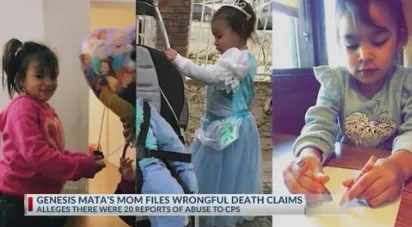
Genesis Mata must not be remembered only for how she died. She was more than the violence inflicted upon her. She was a child with a name, a voice, and a personality that the world never fully got to know.

Somewhere in her short life, there were moments of joy—small, fleeting, but real. Those moments matter, even if they were overshadowed by cruelty.
When we speak her name, we must do so with care. Not as a symbol of rage alone, but as a reminder of what is at stake when children are not protected.
Genesis’s story demands more than attention—it demands action. Better systems. Faster intervention. A culture that listens when something feels wrong.
Child abuse thrives in secrecy. It survives when fear, control, and silence go unchallenged.

The only antidote is vigilance—by communities, institutions, and individuals willing to notice, question, and report.
Genesis could not ask for help in a way that saved her. But her story can still speak for others who are living in similar danger. That is the responsibility left to those who hear it.
Her life should have been long. Her future should have been open. What remains now is memory—and the obligation to ensure that no child endures what she did without someone stepping in.
Rest in peace, Genesis Mata.
You were a child who deserved safety.
You will not be forgotten.