The Twins on the Mountain: A Mystery the Authorities Can’t Explain 3702c

On the afternoon of March 8, 2025, atop a wind-swept ridge overlooking the quiet waters of Lake Chatuge, two young lives came to a sudden and shocking end.
Nineteen-year-old twin brothers,
Qaadir Malik Lewis and Naazir Rahim Lewis, were found dead on Bell Mountain—an isolated summit in Hiawassee, Georgia, known more for its scenic views than for unsolved mysteries. Both had suffered fatal gunshot wounds. Both were pronounced dead at the scene. Both left behind a devastated family who still insists that the official version of events cannot be the truth.
Within days, the Georgia Bureau of Investigation (GBI) delivered its conclusion:
a double suicide.
According to investigators, cellphone data, internet searches, surveillance footage, and forensic evidence all indicated that each brother acted alone, firing the weapon individually—one after the other.
But for the Lewis family, this explanation raised more questions than it answered.
And as the months passed, the tragedy has only deepened into something else—a mystery that refuses to settle
.
This is the story the GBI has closed.
But it is not the story the family—or the growing number of people watching this case—are willing to accept.

THE DAY EVERYTHING STOPPED MAKING SENSE
To understand the tension surrounding the case, one must return to the day before the twins died.
On March 7, 2025, Qaadir and Naazir were supposed to board a flight from Atlanta to Boston. It wasn’t a spur-of-the-moment trip; it had been discussed, planned, and paid for. Their mother said they were excited, even playful, as they prepared to leave the house that morning.
But the twins never made it onto the flight.
Both airline tickets—unused, unscanned, untouched—were later found in their wallets.
That same night, around 10:42 PM, surveillance footage captured them inside a gas station. The video is ordinary, almost painfully so. The brothers appear calm, relaxed, behaving as they always did—talking, browsing, laughing quietly with each other.
Nothing about the footage suggests two young men preparing to carry out a double suicide within 24 hours.
No distress.
No anxiety.
No visible indication of crisis.
Shortly after, the twins disappeared from all communication.
Within hours, they were dead.

THE MOUNTAIN THEY NEVER KNEW
Bell Mountain is an odd place to die.
It is remote.
It is secluded.
It is the last place anyone who knew the twins would expect them to go.
The Lewis family insists—emphatically—that the twins had no ties to Hiawassee, no interest in Bell Mountain, and no logical reason to travel there.
“This wasn’t their kind of place,” one family member said. “They had never been up there. They didn’t hike. They didn’t sightsee. They would never just decide to drive into the mountains alone.”
The GBI states that cellphone pings place the twins near the mountain on the morning of March 8. Yet the exact movements leading up to their arrival remain vague in the official narrative.
What brought them there?
A choice?
A threat?
A person?
The investigation answers none of these questions.
And that is precisely the problem.

THE OFFICIAL STORY: A DOUBLE SUICIDE
The GBI’s ruling rests on four pieces of evidence:
-
Cellphone data
-
Internet searches allegedly related to self-harm
-
Surveillance footage showing normal behavior
-
Forensic findings that investigators claim indicate self-inflicted wounds
It is a neat, clean conclusion—one that allows law enforcement to close the case and move on.
But for the people who loved the Lewis twins, neat and clean does not equal true.
Because if the twins intended to end their lives:
-
Why did they purchase tickets to Boston?
-
Why did they pack for a trip they apparently never meant to take?
-
Why did they behave normally hours before?
-
Why leave no note, no message, no signal of distress?
-
Why choose a mountain they had never visited?
-
And why, above all, would two young men end their lives together but separately, each supposedly firing the same weapon independently?
The scenario strains belief.
Even suicide experts have acknowledged that simultaneous, independent twin suicides are extraordinarily rare—nearly unheard of—without clear, documented planning.
And in this case, the planning simply isn’t there.

THE FAMILY’S REFUSAL TO ACCEPT THE NARRATIVE
From the beginning, the Lewis family has been unwavering in their stance:
The twins did not take their own lives.
They describe the young men as:
-
close-knit
-
protective of one another
-
emotionally stable
-
future-focused
-
deeply connected to their family
-
not the type to disappear without explanation
“They were inseparable,” their mother said. “If one was hurting, he would tell someone. If one was scared, the other would know. They did everything together, but not something like this. Not this.”
The family believes that the evidence was interpreted too quickly, that the investigation was narrowed before all possibilities were exhausted.
Their concerns include:
-
the lack of publicly released details
-
the unusual decision to classify the case rapidly
-
the absence of additional interviews or follow-up leads
-
possible overlooked digital evidence
-
potential coercion or involvement by unknown individuals
To them, the ruling doesn’t feel like closure.
It feels like avoidance.

THE MISSING PIECES
There are gaps in the timeline that still have not been filled.
For instance:
-
How did the twins get to Bell Mountain?
No video or witness accounts place them on the road leading up the steep climb. -
Who else may have been with them?
No details have been released regarding vehicle analysis or secondary DNA. -
Why were their phones reportedly inactive for certain periods?
-
Why was no motive established?
Suicide cases almost always reveal emotional, relational, or psychological triggers. -
Why did both brothers die by firearm—a method neither had history or familiarity with?
The family believes that until these questions are addressed, the suicide ruling is incomplete at best—and deeply flawed at worst.

THE WEIGHT OF A COMMUNITY’S DOUBT
As the case has circulated online, the public has begun to echo the family’s suspicions. The details simply do not align with expected patterns of suicide, especially for bonded twins.
Instead, the case resembles something else entirely:
A scenario where two young men went somewhere they did not intend to go.
A location chosen for them, not by them.
A tragic outcome that was arranged, not planned.
No theory has been proven.
But no theory has been disproven, either.
And that uncertainty continues to haunt the community.

THE BROTHERS BEHIND THE HEADLINES
Lost in the swirl of suspicion are two teenagers who lived full, hopeful lives before their sudden deaths.
Qaadir and Naazir were described as:
-
funny
-
loyal
-
energetic
-
constantly together
-
always looking out for family
-
full of plans for the future
Their mother said they had talked about starting a business together. They were excited about the idea of traveling, working, and building something of their own.
They were not boys who gave up.
They were not boys who vanished silently.
They were not boys who planned to die.
And perhaps that is the most important detail of all.

THE FAMILY’S CONTINUED FIGHT FOR ANSWERS
Despite the GBI’s conclusion, the Lewis family refuses to step back. They are actively:
-
pushing for a reopened investigation
-
requesting independent forensic analysis
-
pressing for release of additional case files
-
seeking legal avenues for review
-
appealing for witnesses or tips
Their message is clear:
“We will not stop until we know what happened. Our boys did not do this.”
For them, justice is not optional—it is the only path forward.

A MYSTERY THAT STILL LIVES ON THE MOUNTAIN
Bell Mountain remains quiet.
Visitors still climb its summit for the view.
The wind still whistles across the jagged rocks.
And the overlook still watches silently over the lake below.
But for those who know the story, the mountain now feels different—haunted not by spirits, but by questions.

Two brothers died there.
Two families were shattered.
And the truth behind their final hours remains hidden in the shadows.
Until those shadows lift, the story of Qaadir and Naazir Lewis will not rest.
It cannot.
Because sometimes a tragedy is not just a tragedy.
Sometimes it is a puzzle.
Sometimes it is a warning.
And sometimes it is the beginning of a fight for answers that should never have been needed in the first place.
Max on Flight 482: The Golden Labrador Who Turned Fear Into Peace 1121
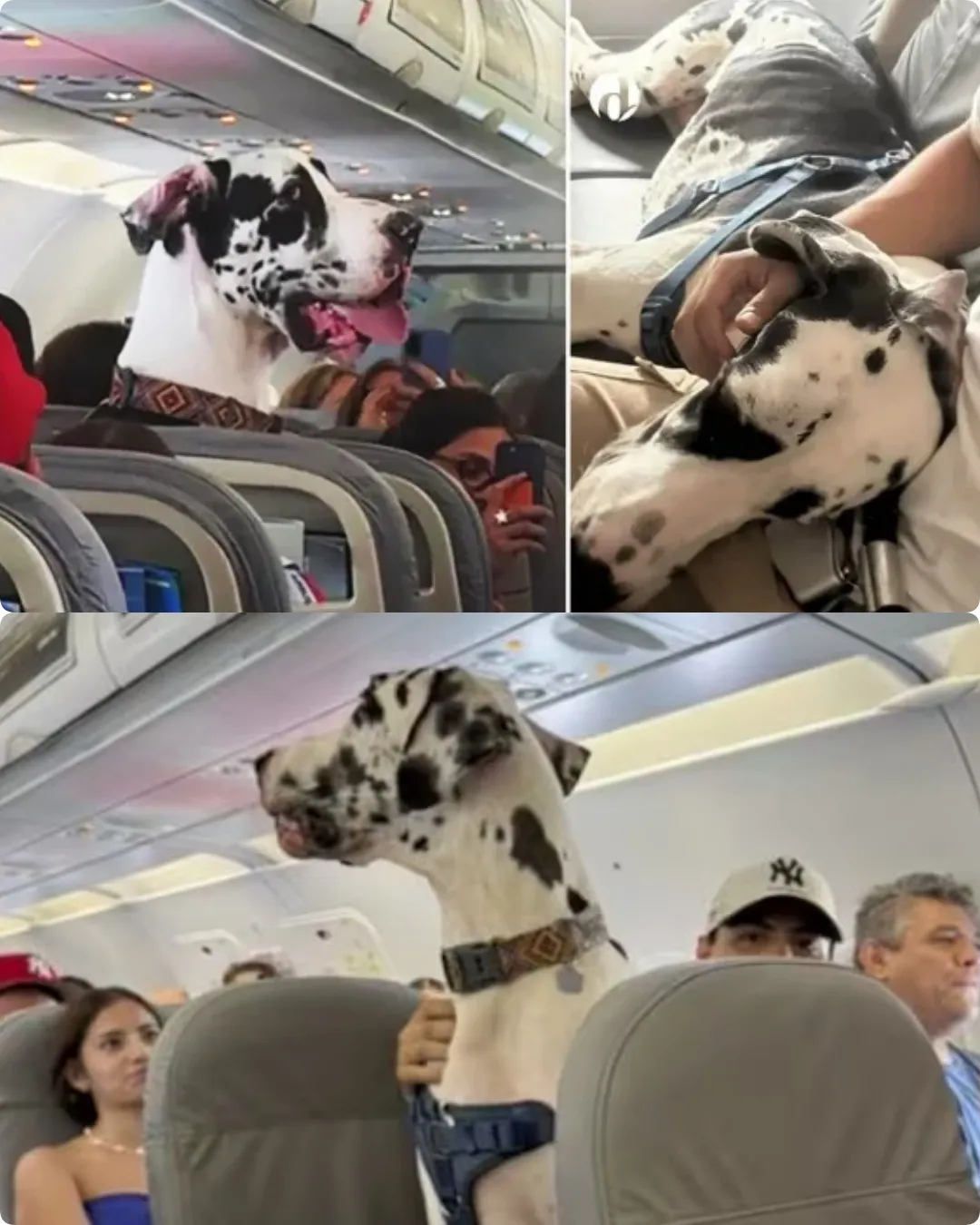
The flight from Dallas to New York was expected to be uneventful, a few short hours in the air for a cabin full of strangers headed to their destinations. But on Flight 482, one small passenger’s heartbreak would transform the journey into something unforgettable—and the quiet hero would be a golden Labrador named Max.
She boarded the plane alone, clutching a backpack with both arms as though it were the only safe thing she had. She couldn’t stop crying. Her shoulders shook, her face buried in her hands, sobs spilling out in waves. Passengers glanced uncomfortably. Flight attendants hurried over, crouching beside her with tissues and soothing words, but nothing helped. Fear had dug its claws in deep.
At first, many thought she was simply nervous about flying. But the way she trembled suggested something heavier. Her cries filled the cabin in a way no one could ignore. Even seasoned travelers fidgeted in their seats, wishing they knew how to help.
That was when Max made his move. The golden Labrador, a trained service dog, had been sitting quietly at his handler’s side a few rows back. Calm and steady, he watched the girl with intent, his instincts sharper than any human’s. His handler noticed his restlessness, the way he leaned forward, ears pricked, ready to act. With a small nod of permission, Max slipped into the aisle.
He padded forward, his nails clicking softly against the floor. Passengers turned to watch. Service dogs are trained to work, not wander, but Max’s steps had purpose. He stopped beside the empty seat next to the girl, glanced at his handler one last time, and then climbed into the chair as if it had always been waiting for him.
The girl didn’t notice at first. Her face was still hidden, her body locked in fear. Then she felt the warmth of him beside her. She peeked out through tear-stained eyes—and froze. A pair of steady, golden-brown eyes gazed back at her.
Max didn’t bark. He didn’t move closer. He simply sat, calm and still, his gaze holding hers. It was an invitation, unspoken but powerful: You are safe now.
Something shifted in that moment. The sobs slowed, the trembling softened. She reached out tentatively, her fingers brushing his fur. Max blinked slowly, patient and accepting. That was all it took. A small smile flickered across her face, fragile but real.
The cabin exhaled with her. Passengers leaned back in their seats, relief rippling quietly through the rows. Flight attendants exchanged glances of wonder. No words had worked. No promises had soothed. But Max had reached her where nothing else could.
For the rest of the flight, the girl leaned against him as though he were an anchor in the storm. She whispered softly to him, telling secrets only he would ever know. Passengers nearby heard her giggle—a sound so light it seemed impossible it had come from the same child who had boarded sobbing.
Max listened in silence, his head resting gently against her arm. He was steady, unmovable, a wall of comfort she could lean into without fear of it disappearing. Every few minutes, she stroked his fur, grounding herself in the rhythm of his presence.
The flight stretched on, but the transformation never faded. What began as panic had become peace. What began as fear had become trust. The child who had seemed inconsolable now looked like any other little traveler—eyes wide with stories, heart open to the journey.
By the time the wheels touched down in New York, she was asleep against his side, her small hand tangled in his golden coat. The cabin was silent except for the hum of descent. Strangers wiped at their eyes, deeply moved by the quiet miracle they had just witnessed.
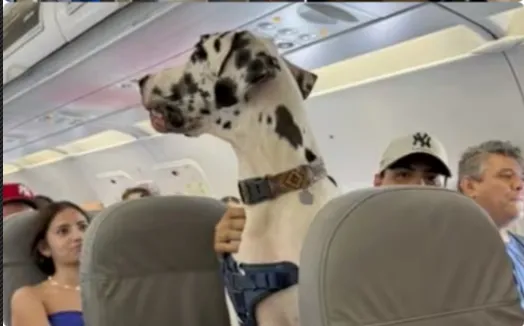
No applause marked the moment. No announcement was made. But every person on Flight 482 carried the story with them as they disembarked. They had seen a service dog step beyond training into something larger: compassion.
Service dogs like Max are trained to sense distress, to provide calm and stability. But there are moments when it feels like more than training—when it feels like instinct, when it feels like love. On that flight, Max didn’t just do his job. He changed a memory.
For the girl, the flight could have been her worst nightmare. Instead, it became a story of kindness and connection, one she may remember for the rest of her life. The fear she carried onto the plane was real. But the comfort she found in Max was just as real—and infinitely more powerful.
For everyone else, it was a reminder. A reminder that healing doesn’t always come from words or explanations. Sometimes it comes from presence. Sometimes it comes from a steady gaze, a warm body pressed close, a heartbeat strong enough to steady your own.
When the doors opened and passengers filed out, many glanced back at Max. He sat calmly, his tail wagging once, his work complete. He hadn’t asked for attention. He hadn’t sought recognition. He had simply been what she needed most.
And in that act, Max became more than a service dog. He became a healer, a guardian, and a symbol of how even the smallest gestures—just sitting still, just being there—can transform fear into peace.