Two Days After Open-Heart Surgery, a Tiny Boy Shows the Bravest Signs of Healing.2417

Two days after surgery, the hospital room felt different.
The steady beeping of the monitors was still there, the soft hum of machines still filled the air — but now, there was something new. Hope.

Knox had been through more in his short life than most adults could bear. Countless hospital stays, endless tubes, medications, and long nights when his parents could do nothing but watch and pray. But this time, for the first time in a long while, things were looking up.
Two days post-op, and not a single episode of vomiting.

For months, Knox had been vomiting over ten times a day. It had become part of his family’s rhythm — heartbreaking and exhausting, a cruel reminder of how fragile his tiny body was. But now, as his mother carefully watched him sleep, she realized something incredible: her little boy hadn’t gagged once.
That silence — the absence of sickness — was the sound of healing.
At 3 o’clock that afternoon, they planned to try purées for the first time. For most parents, that would be an ordinary milestone. For Knox’s parents, it was monumental — a test of whether his body was truly starting to recover.

Just 48 hours before, they had faced the terrifying uncertainty of open-heart surgery once again.
The surgeons had gone in to perform the Glenn procedure — a complex operation to improve the blood flow to the right side of his heart. They had warned it would be difficult, but no one expected what they found once they opened his chest.

Knox’s heart tissue was wrapped in dense layers of scar tissue from previous surgeries. The doctors had to work with the utmost care, each move deliberate and precise. They realized they couldn’t remove the last shunt completely; doing so would risk tearing the aorta — a fatal complication.
Instead, they made a choice.

They reconstructed his heart as best they could, shifting circulation toward the right side and opening the upper chamber to improve oxygen flow. It wasn’t a perfect fix, but it was safe — and it gave Knox a fighting chance.
When the surgeon finally stepped out and said, “Everything went well,” his mother collapsed into tears. They weren’t tears of fear this time. They were tears of relief — of gratitude that her little boy was still here.

The first hours in recovery were tense.
Knox was still on oxygen, his small chest rising and falling in fragile rhythm. The nurses moved quietly around him, checking tubes, adjusting machines, whispering reassurances. But slowly, minute by minute, things began to change.

The chest tube came out. No signs of chylothorax — the complication that had haunted his last surgery. The arterial line came out next, then the central line. One by one, the cords that once bound him to machines disappeared.
And then came the biggest moment of all — he no longer needed oxygen.
He was breathing on his own.

His oxygen levels held steady in the mid-70s — a number that, for Knox, meant stability.
The nurses exchanged smiles. One of them leaned over and whispered, “He’s one of the happiest babies we’ve ever seen after surgery.”
Even after everything his little body had endured, Knox was calm, alert, and full of light. His tiny hand reached for his mother’s fingers and didn’t let go.
For her, that small gesture said everything: I’m still fighting, Mom.

Days in the hospital have a strange rhythm — a blur of hope and fear, joy and exhaustion. But this time, the rhythm was gentler.
Knox was off morphine. The doctors were weaning him off tramadol. His breathing was strong, his coloring brighter. Every morning, his mother woke with cautious optimism — afraid to hope too much, but unable to stop herself.

She thought of the nights she’d spent in sterile waiting rooms, her hands folded, her heart begging for one more tomorrow. She thought of all the prayers whispered into hospital pillows, of strangers across the world sending love and faith through screens.
Now, those prayers seemed to be answering.
Knox was healing. Slowly, bravely, beautifully.
The doctors were amazed at his progress. They said his recovery attitude was remarkable — cheerful, peaceful, almost as if he understood that he’d made it through the storm.

His parents know that the road ahead won’t be easy. The scar tissue remains, and his arteries may narrow over time. There will be more checkups, more anxious waits, more unknowns.
But today — today he is breathing freely. Eating again. Laughing softly.
And that is enough.

For a family that has lived for months between fear and faith, every heartbeat now feels like a gift. Every smile, a miracle.
Soon, they hope to go home. To tuck him into his own bed, not a hospital crib. To watch him play without wires, without pain, without fear.
Knox’s mother shared the update online — her words trembling with gratitude:
“Keep praying for our little boy. Every prayer has brought us this far. He’s doing amazing — better than we dared to hope.”

Sometimes, miracles don’t come in flashes of light. Sometimes, they come in tiny victories — one less tube, one stronger breath, one little boy who keeps fighting long after the world expects him to stop.
Knox’s story is one of those miracles.
The story of a little heart rebuilt — and a love that refused to break.
The Thirsty Koala Who Asked for Help.906
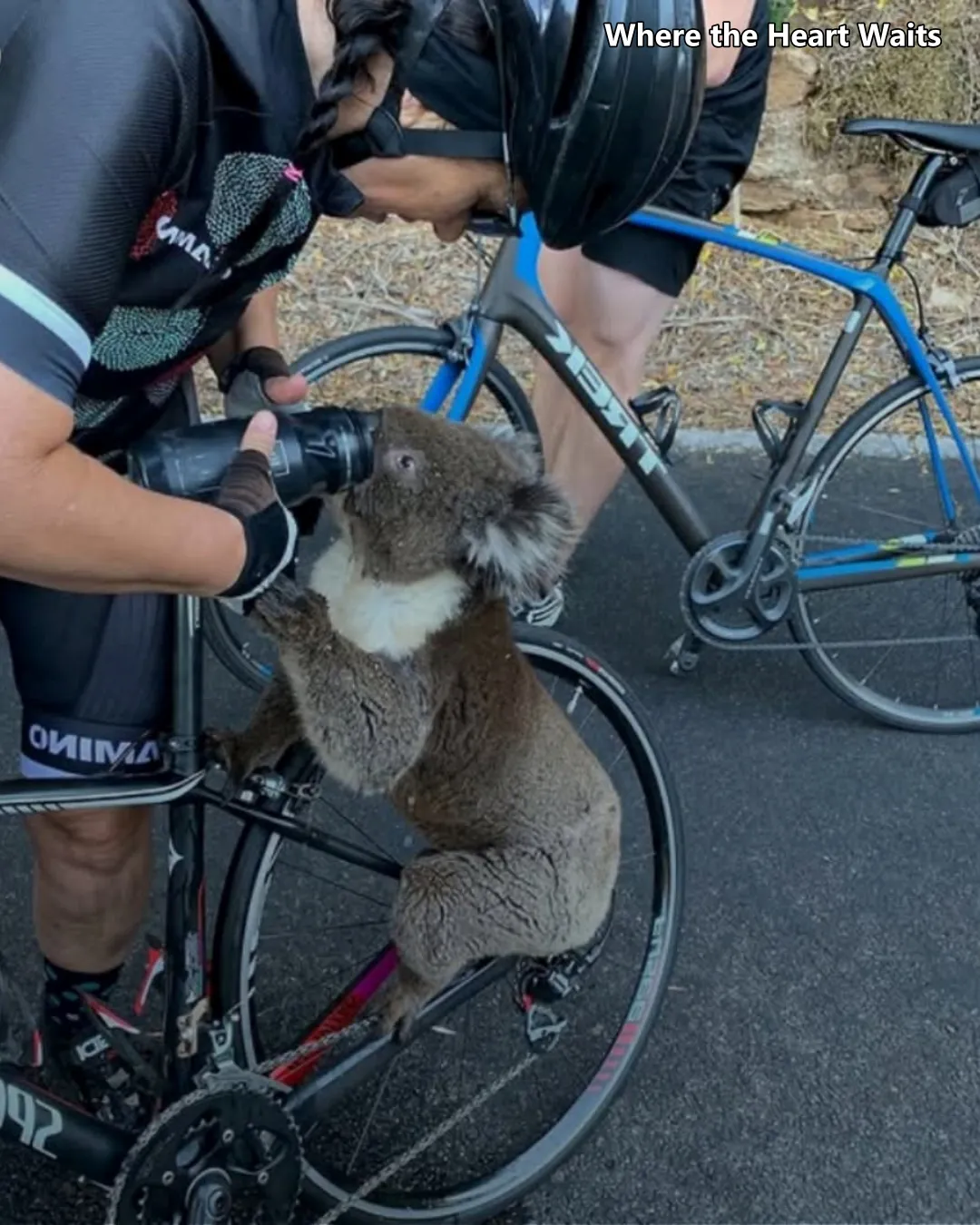
Australia has always been known as a land of unique wildlife, but during times of extreme heat and devastating wildfires, these animals often struggle to survive. For many, every drop of water becomes a lifeline.
One little koala recently showed the world just how powerful the will to survive—and the kindness of strangers—can be.
Last week, Anna Heusler from Adelaide was on a cycling trip with her friends when something unusual happened. As the group made their way down the road, they noticed a koala in front of them. Normally, such an encounter would mean watching from a distance. Koalas are shy by nature and rarely approach people. But this one was different.
As Anna slowed her bike, the koala did something extraordinary. Instead of retreating into the trees, he walked straight up to her, looked into her eyes, and climbed right onto her bike. For a moment, everyone froze in awe. It was as if the animal had been waiting specifically for them.
“He walked right up to me as I was descending and climbed up onto my bike,” Anna recalled.
The message was clear: the koala was desperate for help. The land around them was scorched, the air hot and dry, and the poor creature’s body showed the toll of the sweltering heat. He wasn’t looking for food or shelter—he needed water.
Anna and her friends acted quickly. They pulled out their water bottles and gently offered them to the koala. What happened next touched their hearts forever.
The koala wrapped his paws around the bottle and began to drink eagerly, gulping down every drop. The cyclists passed more bottles forward, and he continued, drinking deeply as if he hadn’t felt relief in days.
In that quiet moment, human and animal stood together in unity—one offering survival, the other showing trust.
“It was genuinely the best thing they’ve witnessed,” Anna later wrote. “What a truly wonderful experience.”
Once the koala had his fill, the group carefully guided him off the road and back toward safety, making sure he was away from passing cars. He moved slowly but seemed stronger, rejuvenated by the kindness of strangers who had stopped their ride to give him what he needed most.

The encounter was brief, but its impact was lasting. For Anna and her friends, it was a reminder of how fragile life can be during natural disasters, and how small acts of compassion can mean the difference between despair and survival.
For the koala, it was proof that even in a world filled with fire, drought, and hardship, there are still people willing to care.
The wildfires across Australia continue to destroy habitats, leaving countless animals in search of water and food. Many never find it. But on that hot afternoon, this one lucky koala did. And in doing so, he gave the cyclists a gift they will never forget—the chance to help, to connect, and to witness firsthand the bond that can exist between humans and the wild.
In the end, the koala walked back into the forest, carrying with him renewed strength. The cyclists rode away carrying something too: a memory of compassion in its purest form.